
There’s a version of aging care that focuses almost entirely on physical safety and medical management. And those things matter they’re not optional. But they’re not sufficient either. Human beings need more than safe shelter and managed medications to thrive. They need to feel that their life still has meaning, that they are still themselves, that the years ahead hold things worth being present for.
For seniors, maintaining a sense of purpose and identity is not a luxury add-on to good care. It’s central to quality of life, and there is growing evidence that it has real health implications as well. Understanding what purpose and identity mean for older adults and how families and caregivers can support them is part of what separates good senior care from genuinely excellent care.
Why Purpose Matters More Than We Usually Acknowledge
Research on longevity and aging consistently highlights a sense of purpose as one of the most powerful predictors of healthy aging. Seniors who report feeling that their lives have meaning and that they have reasons to get up in the morning tend to maintain better physical health, lower rates of depression, and stronger cognitive function over time. This isn’t just a feel-good observation; it reflects real physiological effects of psychological wellbeing.
The challenge is that aging can systematically erode the sources of purpose that a person built their life around. Retirement removes the identity and structure that came from a career. Physical limitations may mean that hobbies that provided meaning are no longer accessible in the same form. The loss of a spouse or close friends creates holes in the social fabric that provided context and belonging. Driving cessation cuts people off from activities and communities that connected them to something larger than themselves.
None of this is inevitable or irreversible. But addressing it requires intentionality from the seniors themselves, where possible, and from the family members and care professionals around them.
Identity Goes Deeper Than What Someone Can Still Do
One of the more subtle harms of care that’s focused exclusively on function is that it can, without meaning to, reduce a person to their limitations. When every interaction with a senior revolves around what they need help with, what they can no longer manage, what risks they present the person’s history, values, personality, and selfhood become invisible.
Good care recognizes that the senior sitting in front of you had a whole life before their current situation. They had a career or vocation that shaped who they are. They had relationships, adventures, and accomplishments. They have opinions about things that matter to them. They have favorite music, favorite stories, a sense of humor that belongs specifically to them.
When caregivers and family members engage with seniors as full people rather than as recipients of care, something real shifts. Seniors feel seen. They are more likely to engage actively with their own care. They are less likely to experience the passive withdrawal that sometimes gets labeled as depression but is actually a response to being treated as if their inner life no longer matters.
Practical Ways to Support Ongoing Purpose
Helping a senior maintain purpose doesn’t always require big interventions. Often it’s the accumulation of small things that matter most. Here are some approaches that families and caregivers find genuinely useful.
Find out what a senior has always cared about, and look for ways to keep those threads alive. Someone who was an avid gardener might not be able to maintain a large garden anymore, but tending a few containers on a porch or windowsill preserves the connection to something they love. Someone who was a gifted cook and prided themselves on feeding others might enjoy supervising meal preparation and teaching a caregiver a family recipe, even if they’re no longer doing the cooking themselves.
Intergenerational connection is one of the most reliable sources of renewed purpose for seniors. Many older adults light up when given the opportunity to share what they know with younger people whether that’s through formal programs or informal family relationships. Grandchildren who ask genuine questions about a grandparent’s life, memories, and knowledge are doing something more valuable than they may realize.
Volunteer opportunities adapted for seniors’ capabilities exist in most communities and can be enormously meaningful. Writing letters, making calls for a charitable organization, being a pen pal to a child in a hospital, mentoring through a program that accommodates limited mobility these activities connect seniors to something outside themselves and reinforce the sense that their presence in the world still matters.
Maintaining Identity Through Difficult Transitions
Some of the most important moments for identity support are during difficult transitions: a move from one living situation to another, a major health event, the loss of a driver’s license, the death of a spouse. These transitions can destabilize a senior’s sense of who they are in fundamental ways.
Families and caregivers who are attentive to this can make a real difference. Bringing meaningful objects from a previous home when someone moves. Continuing to refer to a senior’s former professional identity in conversation “you know, with all your years as a teacher, your perspective on this is really helpful” validates who they were and still are. Marking important personal dates and milestones, celebrating the things that matter to them rather than just the generic ones, communicates that who they specifically are is still known and valued.
For seniors with cognitive decline, identity support takes on additional dimensions. As memory fades, the people around a person become the keepers of their story. Family members who share memories, who tell and retell the narratives that defined a person, perform an act of profound care. So do caregivers who are briefed on a client’s history and who engage with that history authentically rather than treating the person as a clean slate.
The Role of Caregivers in Supporting Purpose
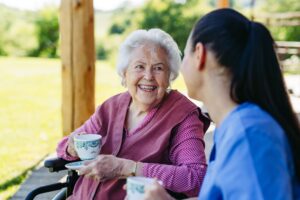
A home caregiver who shows up, performs tasks efficiently, and leaves is providing a certain kind of value. But a caregiver who shows up, notices what makes a client light up, asks questions that invite genuine conversation, and treats each interaction as an opportunity to connect with the whole person is providing something categorically different.
This is one reason why caregiver matching finding someone whose personality and genuine interests resonate with a client’s matters so much. Two people who discover a shared love of a particular kind of music, or who both follow a sport, or who share a background, will build a relationship that sustains the client’s sense of self in ways that are hard to manufacture.
At B Home Care, we believe that caregiving at its best is a relationship, not just a service. We think about this when we match caregivers to clients, and we think about it in how we train and support our team. If maintaining your loved one’s sense of purpose and identity matters to you and we suspect it does we’d love to tell you more about our approach. Reach us at 615-395-6353.