
Stroke is a leading cause of long-term disability in the United States, and for many survivors, home is where recovery actually happens not in a hospital or rehabilitation facility, but in the day-to-day environment where real life takes place. Returning home after a stroke can be both hopeful and overwhelming. The physical and cognitive changes involved mean that the home environment and the support available to the survivor matter more than they ever did before.
This article is not a guide to stroke medical treatment that belongs entirely to the medical professionals overseeing a survivor’s care. What it is intended to do is help families understand the non-medical support picture: what recovery at home looks like in practical terms, what challenges commonly arise, and how in-home care can fit into the overall support structure.
Understanding What Changes After a Stroke
Every stroke is different, and the effects depend heavily on which area of the brain was affected and the severity of the event. Some survivors experience primarily physical changes: weakness or paralysis on one side of the body, difficulty with balance and coordination, fatigue that doesn’t resemble ordinary tiredness. Others deal with communication challenges aphasia, which affects the ability to speak, understand language, read, or write, is among the more emotionally difficult effects for both survivors and their families. Cognitive changes, including difficulties with memory, attention, planning, and problem-solving, are also common.
Emotional changes are often underestimated by families. Depression is very common after stroke not just as a psychological response to the experience, but partly as a direct neurological effect. Anxiety, emotional lability (unexpected crying or laughing), and changes in personality can also occur. Families sometimes find the emotional and behavioral changes harder to adjust to than the physical ones.
The Transition Home from Inpatient Rehabilitation
After a stroke significant enough to require hospitalization, many survivors spend time in an inpatient rehabilitation facility before returning home. This transition from the structured, supervised environment of rehab to the home setting is a critical juncture. The gaps in support that can appear during this transition are where many stroke survivors and their families struggle most.
At the point of discharge from inpatient rehab, a survivor may still be receiving some outpatient therapy physical therapy, occupational therapy, or speech-language pathology but these sessions are typically a few hours per week, not around the clock. The rest of the time, the responsibility for maintaining safety, supporting daily function, and preventing re-hospitalization falls on the home environment.
Family members who haven’t been prepared for what this looks like often find themselves improvising, which is understandably stressful. Understanding in advance what a typical day might involve, what warning signs require immediate medical attention, and what supports are available can significantly reduce that stress.
Where In-Home Care Fits In
It’s important to be clear about what non-medical home care can and cannot do in a post-stroke context. Home care aides are not nurses or therapists, and they do not provide the skilled medical care that nurses provide or the specialized therapy services of licensed physical, occupational, or speech therapists. Those skilled services are provided through home health care, which is typically ordered by a physician and may be covered by Medicare under specific circumstances.
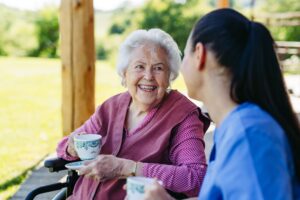
What non-medical home care does provide is consistent, compassionate support with the practical realities of daily life. For a stroke survivor who has weakness on one side, a caregiver can help safely with bathing, dressing, and grooming. For a survivor who fatigues easily, a caregiver handles meal preparation and light housekeeping so the survivor’s limited energy goes toward recovery and the things that matter most to them. For a survivor whose spouse or adult child is working during the day, a caregiver provides supervision and company during the hours when no family member can be present.
This kind of support isn’t a replacement for medical or therapeutic care it works alongside it. Caregivers are also often the first to notice when something seems off: a change in behavior, a new symptom, a decline that the survivor themselves may not be reporting to family or providers. That observational function, while not clinical, has real value.
Home Environment Considerations
For stroke survivors returning home, the physical environment may need to be reassessed. Depending on the nature of the stroke’s effects, stairs, bathroom setups, furniture arrangements, and flooring types that were never a problem before may now pose significant hazards. Occupational therapists, often involved in the discharge planning process, are the right professionals to assess these needs in clinical terms.
Home care agencies working with post-stroke clients should be aware of the environmental context in which care is being provided. Caregivers should be informed about a client’s specific deficits and any accommodations that have been recommended, so that care is provided in a way that supports rather than undermines safety.
Supporting the Caregiver, Too
Spouses and family members who step into the primary caregiver role after a stroke often do so without fully understanding what that will involve or how long it will last. The intensity of post-stroke caregiving particularly in the early months is genuinely demanding. Family caregivers in this situation are at significant risk of burnout, and their own health can deteriorate as a result.
Bringing in professional home care support, even part-time, is not an admission that family members aren’t doing enough. It’s a practical recognition that one person especially one who may also be managing their own health, work, and emotional stress cannot provide twenty-four hours of attention indefinitely without cost to themselves. Supporting the primary caregiver is, in a real sense, also supporting the stroke survivor.
A Note on Expectations and Recovery Timelines
Stroke recovery is not linear, and timelines vary enormously from person to person. Some survivors make remarkable recoveries; others plateau at a level of function that is permanently changed from their pre-stroke baseline. Medical professionals involved in a survivor’s care are the appropriate source of guidance on prognosis and expectations and families should ask those questions directly of the care team rather than relying on general information.
What remains consistent across recovery experiences is that the quality of support medical, therapeutic, and daily caregiving matters. An environment that is safe, that supports appropriate activity and engagement, and that is staffed with people who are genuinely attentive gives stroke survivors the best context for recovery.
How B Home Care Can Help
If your family is navigating post-stroke recovery and trying to understand what in-home support looks like in practice, we’re glad to talk. B Home Care serves families throughout the greater Nashville area, providing non-medical in-home care that supports daily living. We work collaboratively with families and, where appropriate, with the broader care team to ensure that the support we provide fits the broader context of a client’s care. Reach us at 615-395-6353.